As an Amazon Associate this site earns from qualifying purchases.
Specifications
| Product | Brand | Price | Type | Key dimensions | Pieces |
|---|---|---|---|---|---|
| Makeup Organizer with Drawers, Cosmetic Storage for Dresser Vanity and Bathroom Countertop, Beauty Holder for Lipstick Brush, Skincare Organizer for Vanity, Cosmetic Display Case (White) | COMFYROOM | Check price on Amazon | Countertop, 6 sections + 2 drawers | 8.3 x 5.6 x 4.8 in | 1 |
| Vtopmart 10 Pcs Makeup Drawer Organizer Bins Set, 4 Size Plastic Makeup and Vanity Organizer Trays, Clear Acrylic Vanity Storage Containers for Cosmetics, Toiletries, Jewelry, Gadgets, Office Supply | Vtopmart | Check price on Amazon | Drawer trays, 4 sizes | 9x6x2.2, 9x3x2.2, 6x3x2.2, 3x3x2.2 in | 9 bins + 50 silicone pads |
| BiuLeon 25 PCS Plastic Drawer Organizers Set, 4-Sizes Vanity and Makeup Organizer, Desk and bathroom Drawer Organizer Trays, Organizers and Storage for Makeup, Jewelry, Gadgets, Utensils (Pink) | BiuLeon | Check price on Amazon | Drawer trays, 4 sizes, stackable | 8.8x5.5x1.9, 8.7x2.7x1.9, 5.9x2.7x1.9, 2.7x2.7x1.9 in | 25 |
| 4 Pack Acrylic Qtip Holder Dispenser for Cotton Swabs, Balls, Pads, Floss Picks- Small Clear Acrylic Canister Apothecary Jar Set, Bathroom Essentials Accessories Decor, Vanity Makeup Storage Organizer | AOZITA | Check price on Amazon | Lidded acrylic jars | 2 x 12oz, 2 x 10oz | 4 jars + 8 labels |
| Makeup Organizer with 2 Drawers, Makeup Organizers Countertop for Vanity and Bathroom, Make up organization and Skincare Storage with Brush Holder, for Dresser, Desktop, Cosmetic Display Case (White) | fanado | Check price on Amazon | Countertop, compartments + 2 drawers + top tray | 8.3 x 5.7 x 4.5 in | 1 |
| Asayuee 360 Rotating Makeup Organizer for Vanity,2 Tier Large Capacity Skincare Organizers,Bathroom Counter Organizer, Spinning Perfume Organizer & Vanity Organizer (Green-2 Tier) | Asayuee | Check price on Amazon | 2-tier rotating turntable | Not stated | 1 |
Quick answer: Most vanities get messy because everything lives in one flat pile with no assigned home. The fix is boring but reliable — sort by frequency of use, give daily items an open countertop station, put weekly items in divided drawer trays, and store bulk consumables (cotton pads, swabs) in lidded jars so they stop shedding. The products below are cheap plastic and acrylic organizers, and the whole system typically runs under $60.
Before you buy a single tray, do the unglamorous part: empty the vanity completely, check expiry on mascara and liquid foundation, and be ruthless about the six lipsticks you've never reworn. Organizing clutter is just clutter in a nicer box. Once you know what's actually staying, you can size the storage to it instead of guessing.
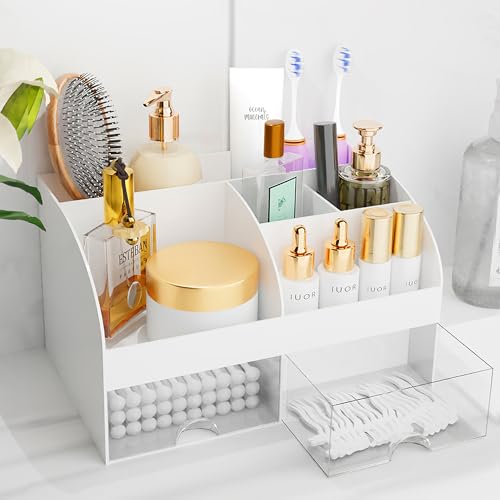
- Multiple Storage Spaces: 8.3in*5.6in*4.8in Small body with large capacity, great cosmetic storage countertop assistant contains 6 Sections and 2 drawers, different compartments
- Premium Material: This plastic makeup organizer is made of high quality environmentally friendly ABS material, non-toxic and tasteless, the material is tough and especially
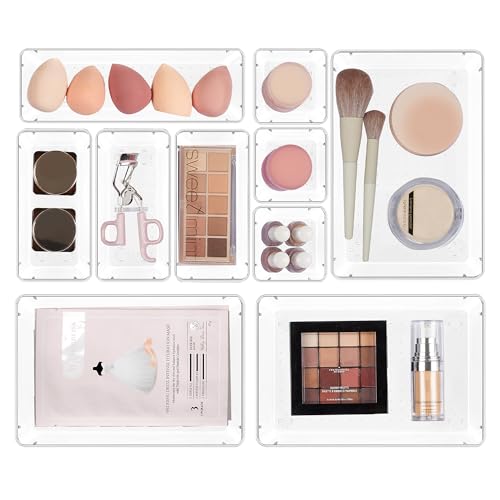
- 【Perfect for Makeup Drawer Storage】Versatile 10pcs drawer organizer can be combined in 9*12 and 9*18 inch drawer in vanity, they are perfect for organizing cosmetics like
- 【4 Different Sizes Drawer Bins】One set drawer organizers includes 9pcs storage bins in 4 different sizes which includes: 9 x 6 x 2.2 inches (3pcs), 9 x 3 x 2.2 inches (1pcs), 6 x
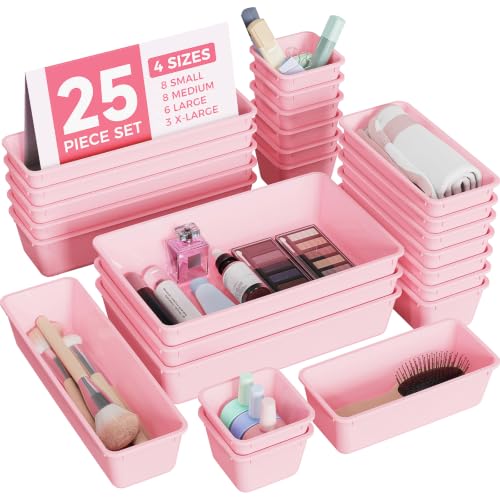
- Durable and Safe Materials: This vanity organizer are made of high-quality safe plastic, sturdy and shatter-resistant for long-lasting use. Specially treated with reinforced
- Non-Slip & Stackable Design: These desk drawer organizer feature a non-slip base to keep trays securely in place during drawer operation. The stackable design allows for compact
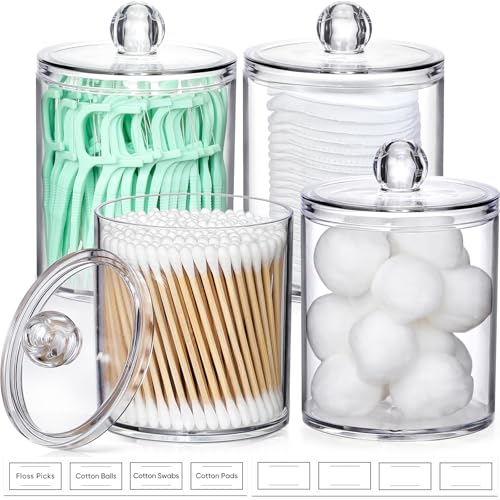
- Item Includes 12 Pcs - 4 pack clear acrylic qtip holder dispenser with lids (2pack 12oz & 2pack 10oz)+ 4 clear labels with black pre-printed words (Cotton Balls, Cotton Swabs
- Ideal Size Storage Containers - These canisters are perfect organizer for small objects, quite easy to store and take out, such as Q-tip, cotton ball, cotton swab, cotton rounds
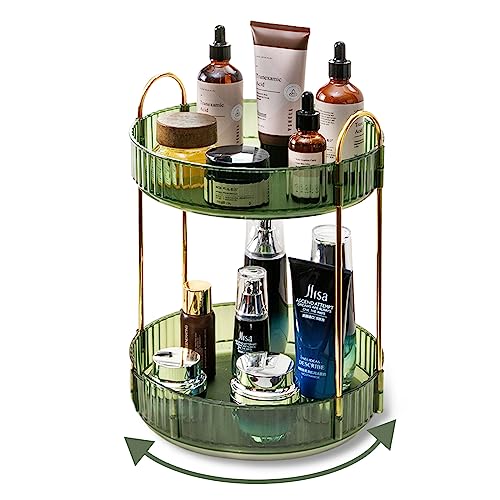
- STREAMLINE YOUR BEAUTY ROUTINE WITH 360° ROTATION - The skincare organizers boasts a large capacity make up organizers and storage with the added convenience of a 360-degree
- EASY TO ASSEMBLE - The Lazy Susan makeup organizer is designed with simplicity and convenience in mind. Assembling the skin care organizer takes less than a minute, allowing you
The three-zone method
Zone 1 — daily, on the counter. The five to ten things you touch every morning. These should never go in a drawer, because a drawer adds friction and friction is why things end up abandoned on the counter anyway.
Finding the right how to organize makeup vanity comes down to matching the features to how you will actually use it.
Zone 2 — weekly, in the top drawer. Palettes, backup lipsticks, tools you use a few times a week. Divided trays here, not loose.
Zone 3 — bulk and refills, low and out of sight. Cotton rounds, swabs, unopened backups. Jars or a lower drawer.
If you're working with a vanity table that has no drawers at all, Zone 2 collapses into Zone 1 and you'll lean harder on a tiered spinner or a compartment caddy.
The countertop station
For Zone 1, a small compartment caddy does more work than its footprint suggests. The Makeup Organizer with Drawers, Cosmetic Storage for Dresser Vanity and Bathroom Countertop, Beauty Holder for Lipstick Brush, Skincare Organizer for Vanity, Cosmetic Display Case (White) from COMFYROOM is 8.3 by 5.6 by 4.8 inches with six sections and two transparent drawers, made from ABS plastic. The upright sections take brushes and mascara; the drawers take flat things like compacts and eyeliner pencils. That's roughly a third of a standard vanity's usable counter width, which is the point — one caddy, not five loose pots.
A caveat worth stating plainly: 4.8 inches of height means tall serum bottles and full-size foundation pumps won't stand in the open sections. Measure your two tallest daily bottles before you commit.
The drawer layer
Loose makeup in a drawer becomes a landslide the first time you open it fast. Divided trays fix this permanently, and this is where most of the visible improvement comes from.
The Vtopmart 10 Pcs Makeup Drawer Organizer Bins Set, 4 Size Plastic Makeup and Vanity Organizer Trays, Clear Acrylic Vanity Storage Containers for Cosmetics, Toiletries, Jewelry, Gadgets, Office Supply set is explicitly designed to combine into 9x12 and 9x18 inch drawers, which covers a lot of standard vanity and dresser drawers. Nine bins across four sizes, plus 50 silicone pads you stick underneath so the trays don't slide when the drawer moves. At 2.2 inches deep, they hold palettes flat and lipsticks upright.
Layout tip: put the 9x6 bins at the back of the drawer and the small 3x3 bins at the front. You reach the front constantly, and small compartments at the front stop the "everything migrates forward" problem.
Bulk consumables
Cotton rounds and swabs shed and spread. Lidded jars solve it and happen to look better than the retail packaging. The 4 Pack Acrylic Qtip Holder Dispenser for Cotton Swabs, Balls, Pads, Floss Picks- Small Clear Acrylic Canister Apothecary Jar Set, Bathroom Essentials Accessories Decor, Vanity Makeup Storage Organizer from AOZITA gives you four lidded acrylic canisters — two 12oz, two 10oz — with pre-printed labels for cotton balls, cotton swabs, cotton pads and floss picks, plus four blank white labels if your categories differ. The lids are the meaningful feature here; open jars in a bathroom collect dust and airborne hairspray.
Who this system is for
- Anyone with a small vanity or a shared bathroom counter where surface area is the binding constraint.
- People whose vanity has one or two shallow drawers currently used as a junk pile.
- Renters and dorm residents who want a fix that requires no drilling, no adhesive, and moves out in a box.
- Anyone on a genuinely tight budget — every item here is under $17.
Who should skip it
- If you own a lot of makeup — think several hundred pieces — small caddies and 2.2-inch trays will just multiply into their own clutter. You want a dedicated multi-drawer unit or a wall system instead.
- If you keep tall bottles. Both countertop caddies here are under 5 inches tall. A tiered spinner handles height better.
- If you want a piece that reads as furniture. These are functional plastic and acrylic. They organize well; they don't decorate a room.
- If your drawers are deep rather than wide, 1.9–2.2 inch trays waste most of the vertical space. Look at stacking or drawer-in-drawer solutions.
Honest trade-offs
Plastic and acrylic organizers scratch. Acrylic in particular hazes over time from powder abrasion and from cleaning with anything harsher than a damp cloth — all of these are listed as wipe-clean with a damp cloth, and that's the ceiling, not a suggestion.
Modular tray sets look flexible in photos but the flexibility depends entirely on your drawer's internal dimensions. A set built around 9-inch modules leaves an awkward gap in a 10.5-inch drawer. Measure the interior of the drawer, not the front panel.
Compartment caddies with fixed sections are the opposite trade: zero flexibility, but zero wasted gaps. If your collection is stable, fixed compartments are actually the better bet.
And the honest one: no organizer creates a habit. The three-zone system works because putting things back is one motion. If you buy trays but keep dropping items on the counter, you'll be back here in six weeks.
What to check on the listing before you buy
- Current price. Everything here is in the $8–$17 range, but prices on this category move constantly. Confirm what's showing today.
- Variant. Several of these have multiple colours, tier counts and piece counts under a single listing, and the price you see may belong to a different variant than the one pictured. The Asayuee spinner in particular is listed in a 2-tier configuration — check which tier count is in your cart.
- Piece count. The BiuLeon set is 25 pieces and the Vtopmart set is 9 bins plus pads; both are sold as "sets" and it's easy to assume they're equivalent.
- Dimensions against your actual drawer. Take the measurement first, then read the listing's size breakdown.
- Warranty and returns. Warranty terms aren't stated for any of these, so lean on the return window instead.
- Reviews. Go read recent reviews yourself, filtered to the variant you're buying — especially photos, which show real-world scale better than the listing images.
Makeup Organizer with 2 Drawers, Makeup Organizers Countertop for Vanity and Bathroom, Make up organization and Skincare Storage with Brush Holder, for Dresser, Desktop, Cosmetic Display Case (White) — consider instead if…
…you want a flat top surface as well as compartments. The Makeup Organizer with 2 Drawers, Makeup Organizers Countertop for Vanity and Bathroom, Make up organization and Skincare Storage with Brush Holder, for Dresser, Desktop, Cosmetic Display Case (White) from fanado is 8.3 x 5.7 x 4.5 inches with five compartments, two clear drawers and a top tray. That top tray is the differentiator — it gives you a landing spot for the item you're mid-routine with, which is exactly where counter clutter starts. Also $8.99, and available in multiple colours.
BiuLeon 25 PCS Plastic Drawer Organizers Set, 4-Sizes Vanity and Makeup Organizer, Desk and bathroom Drawer Organizer Trays, Organizers and Storage for Makeup, Jewelry, Gadgets, Utensils (Pink) — consider instead if…
…you're organizing more than one drawer, or you want trays you can stack when unused. The BiuLeon 25 PCS Plastic Drawer Organizers Set, 4-Sizes Vanity and Makeup Organizer, Desk and bathroom Drawer Organizer Trays, Organizers and Storage for Makeup, Jewelry, Gadgets, Utensils (Pink) gives you 25 pieces for $13.99 — nearly triple the count of the Vtopmart set for 40 cents more — with a non-slip base built in rather than stick-on pads. Sizes run slightly smaller (8.8 x 5.5 down to 2.7 x 2.7, at 1.9 inches deep), so check them against your drawer.
Asayuee 360 Rotating Makeup Organizer for Vanity,2 Tier Large Capacity Skincare Organizers,Bathroom Counter Organizer, Spinning Perfume Organizer & Vanity Organizer (Green-2 Tier) — consider instead if…
…your problem is tall bottles rather than small ones. The Asayuee 360 Rotating Makeup Organizer for Vanity,2 Tier Large Capacity Skincare Organizers,Bathroom Counter Organizer, Spinning Perfume Organizer & Vanity Organizer (Green-2 Tier) is a two-tier spinner with no internal partitions, raised guardrails to stop things sliding off, and deliberate clearance between tiers for taller jars and bottles. It's ABS with gold steel supports, assembles in under a minute and disassembles for cleaning or single-tier use. At $16.98 it's the priciest item here, and it's the right call for skincare and perfume rather than flat palettes.
FAQ
How do I organize a vanity table that has no drawers? Build everything on the counter, vertically. A tiered spinner handles bottles, a compartment caddy handles brushes and small items, and lidded jars handle consumables. Keep the total footprint to about half the counter so you still have working space to actually put makeup on.
Should makeup live in the bathroom at all? Humidity and heat shorten the life of cream products and powders. If your bathroom vents poorly, keep daily items there and store backups and anything expensive somewhere cooler and drier. Lidded containers help, but they don't fix a steamy room.
How often should I reset the vanity? Every three months is a reasonable rhythm. Pull everything out, wipe the trays with a damp cloth, check dates on mascara and liquids, and put back only what you've used since the last reset. The reset is what keeps the system working — the containers just make it fast.
Clear trays or coloured ones? Clear if you struggle to remember what you own, because visibility beats aesthetics for daily use. Coloured or opaque if the drawer is on display or if you find visual noise stressful. It's genuinely a preference, not a performance difference.
Related guides
- Best bathroom fixtures and vanities - bathroom vanities, bidets, vanity tables and makeup vanities After Recent Issues
- Privacy Policy
- Best bathroom fixtures and vanities - bathroom vanities, bidets, vanity tables and makeup vanities for Families
Key Takeaways
- Choosing the right how to organize makeup vanity means matching the key features to your specific needs and budget
- Read real customer reviews and check the return policy before you commit
- Compare value across models — the priciest option is not always the best fit