As an Amazon Associate this site earns from qualifying purchases.
Specification comparison
| Product | Price | Color temps | Brightness levels | Power | Length / format |
|---|---|---|---|---|---|
| DLOMT Vanity Lights for Mirror,LED Makeup Light Strip | Check price on Amazon | 3000K / 5000K / 6500K | 10 levels | USB (5V/2A adapter not included) | Strip, 108 LED beads, tearable segments |
| HELOIE Makeup Light,Portable Led Vanity Lights | Check price on Amazon | 3000–6000K | 10 levels | USB, 6.56 ft cable | 5 bulbs, suction cup mount |
| Led Vanity Mirror Lights, Hollywood Style Vanity Make Up Light, 10ft Ultra Bright White LED, Dimmable Touch Control Lights Strip, for Makeup Vanity Table & Bathroom Mirror, Mirror Not Included | Check price on Amazon | White (single, not stated in K) | Touch dimmer, levels not stated | Not stated | 10 ft strip |
| Rechargeable Vanity Mirror Lights, Magnetic Stick On Makeup Lamp Cordless | See the product list on this page | 3000K / 4500K / 6500K | Stepless 10–100% | 4000mAh battery, USB-C charge | Bar with magnetic 360° head |
| ZOKON 13ft/4M Led Vanity Mirror Lights Kit Bendable NO Need to Cut Vanity Make-up Mirror Cloakroom Adjustable Flexible Strip Light Table Set with Dimmer and Power Supply | Check price on Amazon | Not stated | 1–100% via dimmer | 12V, power supply included | 13 ft / 4 m bendable strip |
| SICCOO Makeup Vanity Lights for Mirror, Hollywood Style LED Vanity Mirror Lights with 14 dimmable Bulbs, USB Cable, White | Check price on Amazon | 3200K / 5000K / 10000K | 10 levels | USB 5V 2A, extra USB port on control | 14 bulbs |
Quick answer: Good vanity lighting comes from the sides of the mirror at roughly face height, not from above, and it should be bright enough and neutral enough in color that your makeup reads the same indoors and out. Overhead ceiling lights are the single most common reason foundation looks fine at home and wrong in daylight. If you're not rewiring anything, a stick-on LED strip or bulb bar with adjustable color temperature is the cheapest way to fix this, and most of them run under $25.
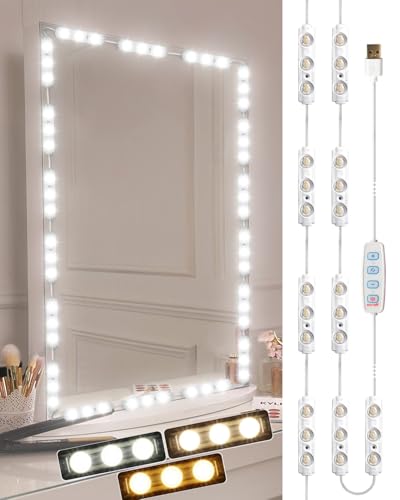
- DIY Glam Vanity Lights: If you have always wanted a hollywood style vanity but not enough to spend hundreds of dollars on one. Elevate your beauty routine with DLOMT mirror
- 3 Light Modes Adjustable Pro: This LED vanity light is beautiful, bright and chic! Perfect for your vanity mirror! Available in 3 color temperatures,warm light at 3000K, neutral
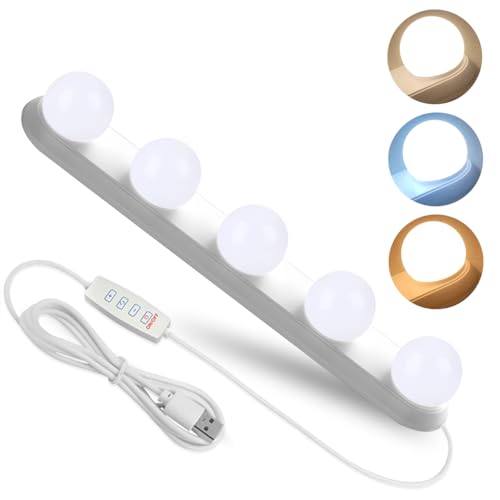
- Bright Vanity Lights: This 5 bulbs makeup lamp has 3000-6000K (warm light - cool light) color temperature optional.10 levels of brightness press button "+" and "-" the switch to
- Easy Installation: No wall drilling or No electrical wiring is required, just stick on firmly suction cup mirror light to a wall mirror or mirror frame and you’re good to go
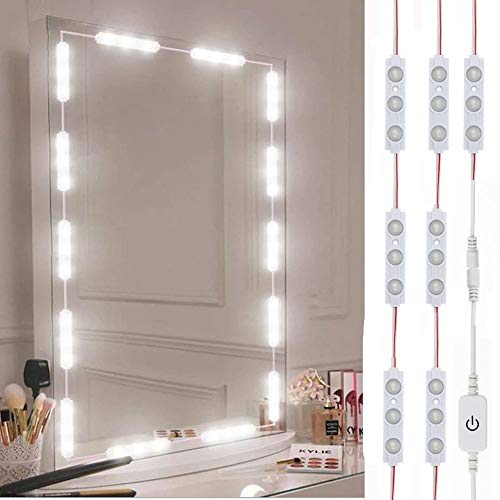
- Perfect for Diy Glam Hollywood Style Vanity - If you have always wanted a Hollywood style vanity but not enough to spend hundreds of dollars on one. These led vanity mirror
- Easy & Stress-free Installation - No wall or holes drilling. Your best beauty investment. No assembly or electrical wiring is required, just stick firmly these led vanity lights
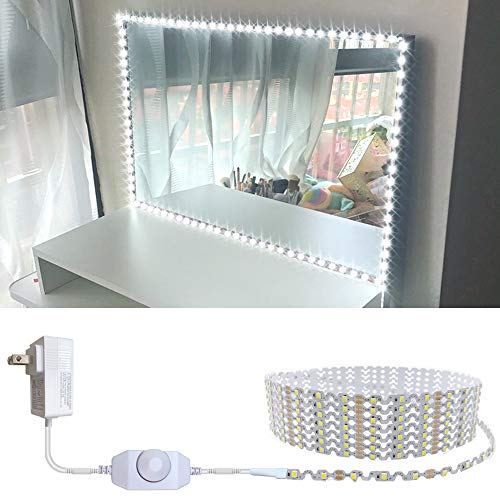
- Package Included and Size: This lighted has a perfect size 13ft/4M.Light strig+12V working voltage+dimmer controller
- Widly Use:This bendable lights not only can you install it to your bedroom vanity mirror, you can also install it to the kitchen mirror,kitchen,display,outdoor courtyard, etc
Why the light source position matters more than the fixture
Light from above casts shadows down — into your eye sockets, under your cheekbones, under your jaw. You compensate for those shadows without realizing it, then step outside and the compensation is visible. Light coming at your face from both sides, at about the height of your eyes to your nose, fills those shadows evenly. That's the entire reason Hollywood-style bulb frames exist.
The second variable is color temperature, measured in Kelvin. Roughly: 3000K is warm and yellow, 5000K is neutral, 6500K is cool daylight. If you do your makeup for daytime, you want something near daylight. If you're getting ready for a dim restaurant, warmer light previews it better. Products with switchable temperature let you check both, which is genuinely useful rather than a spec-sheet gimmick.
The best how to light a makeup vanity for your situation depends on how you plan to use it and where.
Third is brightness control. Full-blast LEDs at 7am are unpleasant, and squinting changes how you apply eye makeup. Dimming isn't a luxury feature here.
The starting point: a mirror-mounted LED strip
For most people the practical answer is a self-adhesive strip run down both vertical edges of the mirror. It puts light where it needs to be, requires no electrician, and costs less than a decent brush.
The DLOMT Vanity Lights for Mirror,LED Makeup Light Strip is a reasonable default at $9.99. It offers the three color temperatures you actually want — 3000K, 5000K and 6500K — plus 10 brightness levels, and the listing states 108 LED chips versus the 60 common on cheaper bars, which is the difference between "lit" and "evenly lit." The adhesive backing is described as tearable by hand, so you separate segments without scissors, and it draws 0.68W per set with a stated 50,000-hour lifespan. Note that the 5V/2A USB adapter is not included, so plan to use one you already own.
Who this approach is for
- Renters, or anyone who doesn't want to drill into a mirror or wall.
- People whose vanity currently relies on a ceiling fixture or a single overhead bar.
- Anyone doing makeup for photo or video, where even, frontal light is non-negotiable.
- Small setups — a dresser, a desk corner, a bathroom mirror doing double duty.
Who should skip it
- If you're mid-renovation and can run wiring, hardwired sconces flanking the mirror are a better permanent answer than any stick-on product here. Adhesive strips are a retrofit, not an upgrade to the room.
- If your mirror is heavily framed or textured, adhesive backing has nothing flat to grip.
- If you want a specific decorative look — brass, glass shades, exposed Edison bulbs — none of these products deliver that. They're functional, not architectural.
- If you never do makeup at the vanity and just want general room light, a strip at face height is the wrong tool.
Honest trade-offs
Adhesive is not permanent. Peel-and-stick backing on a warm, humid bathroom mirror is the classic failure mode. It works, until steam and heat cycles get to it. Bedroom vanities do much better than bathrooms here.
"Ultra bright" and Kelvin claims are marketing until you see them. A 10000K setting, as listed on the SICCOO, is well past daylight into blue territory — some people like it for precision work, others find it clinical. You won't know which you are until it's on your wall.
Strips give even wash; bulbs give sparkle. A continuous strip is more diffuse and more flattering. A bulb bar reads more like a dressing room and casts slightly harder shadows. Neither is wrong; they're different looks.
USB power means a visible cable. Every USB-powered option here ends in a cord that has to reach an outlet. Plan the run before you stick anything down, because repositioning adhesive usually means it never sticks as well again.
Cheap dimmers can flicker. Flicker is invisible to your eye but shows up on camera as banding. If you film, that matters. If you don't, it doesn't.
What to check on the listing before you buy
Listings change constantly, so verify these yourself rather than trusting any article, including this one:
- Current price. All the figures above are point-in-time. Coupons and lightning deals move them.
- Variant selected. Length, color temperature and bulb count are often separate variants at different prices on the same page. The price you see may not be the variant you want.
- What's in the box. Several of these do not include a power adapter. The ZOKON listing states a power supply is included; the DLOMT explicitly says the USB adapter is not. Confirm before you're stuck at 11pm without a plug.
- Warranty and seller. Check who's actually shipping it and what the return window is.
- Reviews with photos. Go read them yourself, and specifically look for user-uploaded photos showing the light on a mirror — that tells you far more about real brightness and color than any spec.
Consider instead if…
HELOIE Makeup Light,Portable Led Vanity Lights — consider instead if…
…you want bulbs rather than a strip, and you want to be able to move the whole thing. The HELOIE Makeup Light,Portable Led Vanity Lights is a 5-bulb bar at $12.99 with a 3000–6000K range and 10 brightness levels. It mounts by suction cup rather than adhesive, which means no drilling and no residue, and the 6.56-foot USB cable can run off a power bank — useful if you get ready somewhere without a convenient outlet, or travel with it.
Led Vanity Mirror Lights, Hollywood Style Vanity Make Up Light, 10ft Ultra Bright White LED, Dimmable Touch Control Lights Strip, for Makeup Vanity Table & Bathroom Mirror, Mirror Not Included — consider instead if…
…you have a large mirror and want one continuous run. The Led Vanity Mirror Lights, Hollywood Style Vanity Make Up Light, 10ft Ultra Bright White LED, Dimmable Touch Control Lights Strip, for Makeup Vanity Table & Bathroom Mirror, Mirror Not Included is a 10-foot strip at $16.99 with a touch dimmer built in, and the listing describes it as waterproof — the only one here making that claim, which is relevant for bathroom use. It's a single white color rather than switchable, so you're committing to one look.
Rechargeable Vanity Mirror Lights, Magnetic Stick On Makeup Lamp Cordless — consider instead if…
…you refuse to have a cable anywhere near your vanity. The Rechargeable Vanity Mirror Lights, Magnetic Stick On Makeup Lamp Cordless runs on a 4000mAh battery, charges by USB-C in a stated 2–3 hours, and detaches from its magnetic base for portable use. It gives 3000K/4500K/6500K, stepless dimming from 10–100% with memory, 360° head rotation, a remote, and 15/30/60-minute auto-off. At $23.99 it's the priciest option here and the only one where battery life becomes part of your routine.
ZOKON 13ft/4M Led Vanity Mirror Lights Kit Bendable NO Need to Cut Vanity Make-up Mirror Cloakroom Adjustable Flexible Strip Light Table Set with Dimmer and Power Supply — consider instead if…
…you're lighting an oddly shaped or oversized mirror. The ZOKON 13ft/4M Led Vanity Mirror Lights Kit Bendable NO Need to Cut Vanity Make-up Mirror Cloakroom Adjustable Flexible Strip Light Table Set with Dimmer and Power Supply is 13 feet of bendable strip at $14.99, runs on 12V with the power supply included, and dims 1–100% from an inline controller. The bendability means curves and corners without cutting.
SICCOO Makeup Vanity Lights for Mirror, Hollywood Style LED Vanity Mirror Lights with 14 dimmable Bulbs, USB Cable, White — consider instead if…
…you specifically want the dressing-room bulb look with more points of light. The SICCOO Makeup Vanity Lights for Mirror, Hollywood Style LED Vanity Mirror Lights with 14 dimmable Bulbs, USB Cable, White has 14 bulbs at $18.99, 10 brightness levels and three modes at 3200K, 5000K and 10000K. It runs on 5V 2A USB, is made with ABS fireproof material per the listing, the bulbs stay cool to the touch, and the control button includes an extra USB port that can charge your phone.
FAQ
Where exactly should the lights go? Vertically down both sides of the mirror, centered around eye-to-nose height. If you can only do one run, put it above the mirror angled down toward your face rather than on the ceiling — still not ideal, but far better than a downlight directly overhead.
What color temperature should I use for everyday makeup? Around 5000K is the safest default because it's close to neutral daylight and won't flatter your blending unrealistically. Products like the DLOMT, HELOIE, SICCOO and Floarligso units let you switch, so you can check a warm setting afterward to preview evening light.
Will adhesive strips damage my mirror? The adhesive sticks to the glass surface, not the silvering, so the mirror itself is usually fine. The risk is residue on removal, and the possibility that a strip pulls off a painted frame's finish. Test on an inconspicuous spot and go slowly with removal.
Is more brightness always better? No. Over-bright light flattens features and makes you under-apply, which is the opposite of the overhead-shadow problem but just as misleading. Dim to a level where you can see detail without squinting, and check your face in a window or outdoors before you leave.
Related guides
- How to Succeed with Best bathroom fixtures and vanities - bathroom vanities, bidets, vanity tables and makeup vanities
- How to Choose a Makeup Vanity: A Buying Guide
- Top 10 Tips for Best bathroom fixtures and vanities - bathroom vanities, bidets, vanity tables and makeup vanities
Key Takeaways
- Choosing the right how to light a makeup vanity means matching the key features to your specific needs and budget
- Read real customer reviews and check the return policy before you commit
- Compare value across models — the priciest option is not always the best fit