As an Amazon Associate this site earns from qualifying purchases.
Comparison Table
| Product | Price | Width | Sink Config | Countertop | Assembly |
|---|---|---|---|---|---|
| AMERLIFE 48" Farmhouse Freestanding Vanity | Check price on Amazon | 48" | Single, integrated deep basin | Acrylic | Required, 2 packages |
| chartustriable 59" Double Vanity (Rustic Grey) | See the product list on this page | 59" (19.6"D x 34.3"H) | Double, ceramic integrated | Ceramic | Required, video provided |
| DELUXE LIVING 48 Inch White Vanity | Check price on Amazon | 48" | Single apron farm sink | Engineered stone | None — arrives assembled |
| LUXOAK 30" Sliding Barn Door Vanity | Check price on Amazon | 29.3" (18.31"D x 33.66"H) | Single, integrated | Not stated | Required, labeled parts |
| HOPUBUY 36" Bathroom Vanity | Check price on Amazon | 31" cabinet (19"D x 34"H) | Single, ceramic integrated | Not stated | Required, labeled parts |
| AMERLIFE 36" Brown Double Sink Vanity | Check price on Amazon | 36" (22"D x 34.3"H) | Double, integrated | Acrylic, 3 faucet holes | Required, 2 cartons |
Quick answer: If you want the classic barn-door farmhouse look without overthinking it, the AMERLIFE 48" Farmhouse Freestanding Vanity with Sink and Deep Basin hits the sweet spot at 48 inches with an integrated deep basin and four drawers. Tight on space or budget? The 30-inch LUXOAK and the 36-inch HOPUBUY cover small bathrooms for under $250. If you want a true apron farm sink and zero assembly, the DELUXE LIVING 48-inch is the splurge.
Farmhouse vanities are one of those categories where the styling is easy and the specs are where people get burned. Barn doors look great in a listing photo and then swing into your toilet clearance. "Farmhouse" gets stamped on cabinets that have a wood-grain print and nothing else going on. And the difference between an integrated acrylic basin and an engineered stone top with an apron sink is roughly $600 — worth knowing before you click.
Here's the honest breakdown of six options, what each one actually gives you, and who should skip it.
Finding the right best farmhouse bathroom vanities comes down to matching the features to how you will actually use it.
AMERLIFE 48" Farmhouse Freestanding Vanity — Best Overall
At $449.99, the AMERLIFE 48" Farmhouse Freestanding Vanity with Sink and Deep Basin is the one I'd point most people toward, because 48 inches is the size that works in the majority of standard single-sink bathrooms without feeling like a dollhouse piece.
The sliding barn doors are the headline — and importantly, sliding doors don't swing outward, so you're not fighting for clearance in a narrow room. Behind them is storage sized for taller items (think a bottle of cleaner standing upright), plus four sliding drawers for the small stuff.
The sink is integrated into a high-strength acrylic top, meaning no seam between bowl and counter to trap grime. AMERLIFE calls out a deep basin to cut down on splashing and a built-in overflow. The handles are black metal, recessed into the doors and drawers with a waterproof coating so they don't rust — a small detail that matters more in a bathroom than anywhere else in the house.
Cabinet is MDF. It ships in two packages and requires assembly.
Skip it if: you need two sinks, or your alcove is under 48 inches.
chartustriable 59" Double Bathroom Vanity — Best for Two Sinks on a Budget
The Double Bathroom Vanity with Sink & Faucet & Sewer Pipes,59" Farmhouse Bathroom Vanity Cabinet Set with 3 Storage Drawers & Sliding Barn Door,Double Sink Vanities With Metal Handle(Rustic Grey) is the value outlier here: $379.99 for a 59-inch double-sink setup that also includes the faucets and sewer pipes in the box. Buying faucets separately for a double vanity is easily another $100+, so factor that in when you compare.
Dimensions are 19.6"D x 59"W x 34.3"H. The countertop is white ceramic with two integrated basins, extending nearly to the edge for maximum usable sink area, with overflow and a deep basin. Storage is three pull-out drawers plus two sliding barn doors covering the larger cabinet space.
The rustic grey finish is more muted than the brown wood-grain options, which reads a little more transitional than full farmhouse — good if your bathroom is otherwise modern.
Construction is MDF. The listing points you to an installation video, and assembly here is genuinely more involved than a 30-inch single — parts are numbered and split into upper and lower groups. Budget an afternoon and a second pair of hands.
Skip it if: you don't have a full 59 inches of wall, or you want a stone-look top.
DELUXE LIVING 48 Inch White Bathroom Vanity — Best for No-Assembly and Real Farm Sink Looks
This is the one that costs real money — $1,019.99 — and the DELUXE LIVING 48 Inch White Bathroom Vanity with Sink, Farmhouse Bathroom Sink Cabinet with Soft Closing Doors & Dovetail Drawers, Single Apron Farm Sink, No Assembly Required earns most of that gap in three places.
First: it arrives fully assembled. No flat-pack, no numbered screws, no evening lost. If you've ever assembled a large vanity and watched it come out slightly racked, you understand what you're paying for.
Second: the countertop is pure white engineered stone, which is non-porous — DELUXE LIVING specifically notes it's stain-resistant and hygienic because there are no pores for anything to sink into. Acrylic tops are fine, but engineered stone is a different tier of surface.
Third: the hardware. Soft-closing doors, dovetail drawers, six drawers plus a cabinet. Dovetail joints in drawer boxes are a woodworking tell — they're what separates furniture from particleboard-with-a-finish. The carcass is MDF and solid wood, surfaced with waterproof paint.
And it's a single apron farm sink, which is the actual defining feature of farmhouse style rather than just barn-door hardware bolted onto a cabinet.
Skip it if: the budget is the constraint. The cheaper picks here do the same job less elegantly.
LUXOAK 30" Farmhouse Sliding Barn Door Vanity — Best for Small Bathrooms
At $239.99 and 18.31"D x 29.3"W x 33.66"H, the LUXOAK 30" Farmhouse Sliding Barn Door Vanity with Sink Cabinet is built for the powder room, the guest bath, or any space where 48 inches was never happening.
Under 18.5 inches deep is genuinely shallow, which is what makes it work in a tight room — you can still walk past it comfortably. The sink is integrated with an overflow and a deep basin, and LUXOAK describes it as impact-resistant, which matters in a small bath where things get knocked around.
Storage is the sliding barn door section plus two independent drawers. That's less than the bigger units offer, obviously, but it's honest storage rather than a fake drawer front.
Two details worth flagging: it includes an anti-tip device, and it has a thick base — both relevant if this is going in a bathroom kids use. All parts are labeled for assembly.
Skip it if: you need counter space to actually set things down. Thirty inches goes fast.
HOPUBUY 36" Bathroom Vanity with Sink — Best Budget Pick
$149.99 is the lowest price in this roundup by a wide margin, and the HOPUBUY 36" Bathroom Vanity with Sink, Farmhouse Vanities does something clever with it: instead of drawers, it goes all-in on shelving.
The cabinet is 19"D x 31"W x 34"H, with a double-door cabinet, an adjustable interior shelf offering three height positions, and three extra side shelves. Those open side shelves are the differentiator — they turn a small vanity into a place to stack folded towels or park a basket, which is the kind of thing renters and small-apartment dwellers actually need.
The sink is ceramic and integrated. Construction is engineered wood and reinforced MDF with stainless steel hinges. Styling is the expected farmhouse package: barn doors, black retro metal handles, vintage wood grain finish.
Assembly is required, with labeled parts and instructions, and HOPUBUY advertises 24/7 customer service support.
Skip it if: you want closed storage only — those side shelves put your stuff on display.
AMERLIFE 36" Brown Farmhouse Double Sink Vanity — Best for Small Double-Sink Setups
The AMERLIFE 36" Brown Farmhouse Double Sink Bathroom Vanity, Solid White Top is the interesting one: $379.99 for a double-sink layout in a 36-inch footprint (36"W x 22"D x 34.3"H).
The countertop is 37"W x 22"D acrylic with three pre-drilled faucet holes and an integrated sink that prevents leakage at the seam. Three faucet holes means widespread-style faucet compatibility — check your faucet's hole spacing before ordering.
Storage is a large cabinet, two sliding drawers, and an open bottom shelf. There's also a built-in paper towel holder that AMERLIFE notes handles tissues or a hair dryer — a genuinely useful bit of design that most vanities ignore.
Hardware details: magnetic latches on the doors, silent slide rails on the drawers, black metal handles, and iron corner decor for the farmhouse look. MDF construction, ships in two cartons, assembly required.
Skip it if: you want deep drawer storage — the open bottom shelf trades enclosure for accessibility.
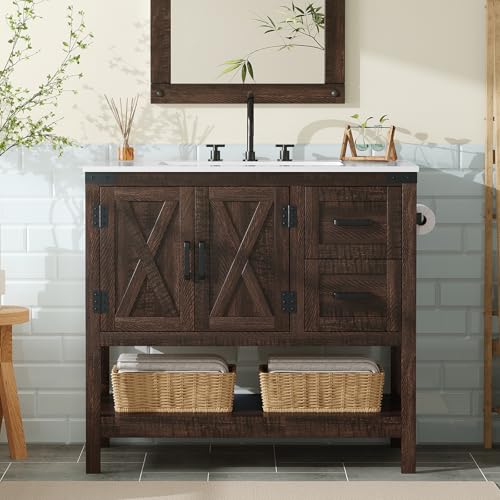
- Farmhouse Bathroom Cabinet: Classic barn door with black metal handles & iron corner decor enhance overall coordination, rustic wood grain finish adds a modern farmhouse style to
- Multi-Purpose Storage Space: Bathroom sink cabinet includes a large cabinet, two sliding drawers & an open bottom shelf, you can place bathroom essentials in any location
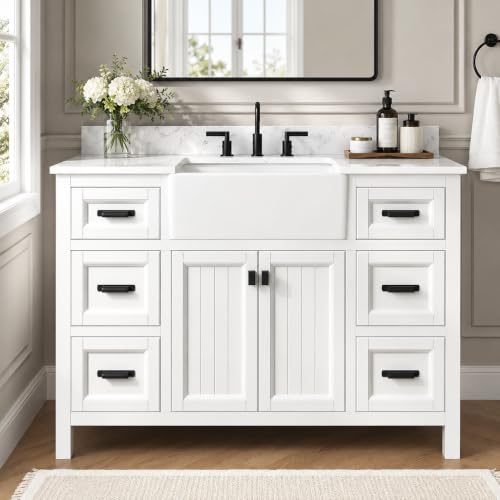
- Fully Assembled - Skip the frustration of complicated assembly and installation mistakes. This 48 inch bathroom vanity with sink arrives fully assembled and ready to install
- Smart Storage - Keep your bathroom clean and organized with 6 spacious drawers and a large cabinet compartment. Designed to store towels, toiletries, hair tools, and daily
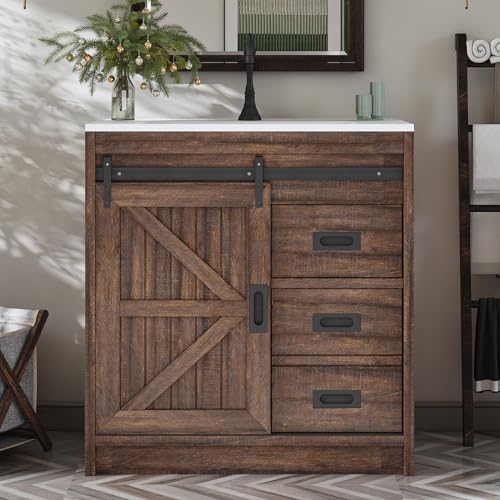
- 【Integrated Sink】Bathroom vanity with an integrated sink that is easy to clean without dead corners, features an overflow, and a deep basin that prevents water from splashing and
- 【Sliding Barn Door Design】 Bathroom vanity features a sliding barn door that opens to reveal storage space and two independent drawers, perfect for keeping your bathroom
How to Choose
Measure the width, then the depth, then the swing. Width is the obvious one, but depth is what makes a small bathroom feel cramped. The LUXOAK at 18.31" deep and HOPUBUY at 19" deep are noticeably shallower than the 22" AMERLIFE 36". In a room where the vanity faces the toilet or the door, two inches is the difference between comfortable and annoying. Barn doors slide rather than swing, which is a real advantage here — every unit in this list except the DELUXE LIVING uses sliding barn doors.
Decide how much assembly you're willing to do. This is the biggest hidden cost. Five of the six require assembly, ranging from "labeled parts, straightforward" (LUXOAK, HOPUBUY) to a 59-inch double-sink build with an instructional video (chartustriable). The DELUXE LIVING is the only one that arrives assembled, and that's a meaningful chunk of its price premium.
Countertop material is where the money goes. Acrylic (AMERLIFE units) is light, seamless with the basin, and easy to clean. Ceramic (chartustriable, HOPUBUY) gives a harder, more traditional surface. Engineered stone (DELUXE LIVING) is non-porous and stain-resistant — the best of the three, and priced accordingly.
Do you actually need two sinks? Double vanities cost more, complicate plumbing, and cut your usable counter space in half. The chartustriable at 59 inches gives each person real room. The AMERLIFE 36" double packs two basins into 36 inches, which works for a shared kids' bath but means less elbow room. If it's one person using the bathroom, a single sink with more counter is the better buy nearly every time.
Check the drawers, not the door count. Cabinet space behind a barn door is good for tall bottles and cleaning supplies. Drawers are what keep toothbrushes and cosmetics from becoming a pile. The DELUXE LIVING leads with six drawers plus a cabinet; the AMERLIFE 48" has four; the LUXOAK has two.
Read the reviews yourself before you buy. Vanity quality varies batch to batch, and the questions worth answering — did it arrive damaged, do the doors align, is the finish consistent — are exactly the things buyers report on. Open the reviews tab and sort by most recent.
FAQ
What actually makes a vanity "farmhouse" style? The signature elements are a sliding barn door with exposed metal rails, black or dark metal hardware, a visible wood grain finish, and — the strongest signal — an apron-front farm sink, where the basin face is exposed rather than tucked under the counter. Of the options here, only the DELUXE LIVING 48 Inch has a true single apron farm sink; the rest deliver the look through barn doors and finish.
Do these come with faucets? Only one states it does. The chartustriable 59" set explicitly includes the sink, faucet, and sewer pipes. The AMERLIFE 36" comes with three pre-drilled faucet holes but the faucet itself isn't listed as included. For the others, plan on buying a faucet separately and confirming hole configuration first.
Is MDF going to hold up in a bathroom? MDF is the standard material at these price points, and every unit here uses it in some form. The manufacturers address moisture differently: DELUXE LIVING combines MDF with solid wood and a waterproof paint surface; AMERLIFE coats the handles with a waterproof finish; HOPUBUY uses reinforced MDF with stainless steel hinges. The practical advice is the same regardless — wipe up standing water and run the exhaust fan.
What size vanity fits a small bathroom? Under 32 inches wide and under 20 inches deep is the safe zone. The LUXOAK 30" (29.3"W x 18.31"D) and HOPUBUY 36" (31"W cabinet x 19"D) both fit that profile, and both are described by their makers as designed for small bathrooms or apartments. Measure your door swing and toilet clearance before committing.
Related guides
- Comparing Your Best bathroom fixtures and vanities - bathroom vanities, bidets, vanity tables and makeup vanities Options
- Best Providers for Best bathroom fixtures and vanities - bathroom vanities, bidets, vanity tables and makeup vanities
- FAQ: Best bathroom fixtures and vanities - bathroom vanities, bidets, vanity tables and makeup vanities
Key Takeaways
- Choosing the right best farmhouse bathroom vanities means matching the key features to your specific needs and budget
- Read real customer reviews and check the return policy before you commit
- Compare value across models — the priciest option is not always the best fit