As an Amazon Associate this site earns from qualifying purchases.
Comparison table
| Vanity | Price | Width × Depth × Height | Countertop | Cabinet material | Assembly | Faucet included |
|---|---|---|---|---|---|---|
| DELUXE LIVING 60" Steel Blue | Check price on Amazon | 60" W, other dims not stated | Quartz | Solid wood frame, waterproof coating | Fully assembled | Not stated |
| DELUXE LIVING 60" Greige | Check price on Amazon | 60" W × 21" D × 33.72" H | Engineered Carrara marble + backsplash | Yellow Poplar solid wood | Fully assembled | No |
| XWNE 72" Dark Walnut | Check price on Amazon | 72" W, other dims not stated | 0.79" stone + backsplash | Solid wood + plywood | Fully assembled | No |
| LUXOAK 61" Farmhouse | Check price on Amazon | 60.6" W × 21.7" D × 33.7" H | Integrated sink | Not stated | Assembly required | Not stated |
| jiteentarou 59" White | See the product list on this page | 59" W × 19.7" D × 31.5" H | Resin integrated sinks | Engineered wood | Not stated | Not stated |
| chartustriable 59" Farmhouse | Check price on Amazon | 59" W × 19.6" D × 34.3" H | Integrated sink | MDF | Assembly required | Yes |
Quick answer: If you want a master bathroom vanity with double sink that arrives fully assembled and looks like it cost more than it did, the DELUXE LIVING 60 Inch Bathroom Vanity Double Sink in Steel Blue with a quartz top is the one to beat. If your budget is under $600, the LUXOAK 61" Farmhouse Double Bathroom Vanity gives you two basins and real storage for a fraction of the price. And if you have a wide wall and want built-in outlet space, the XWNE 72-inch is the only one here that offers it.
A double vanity is one of those upgrades that sounds like a luxury and turns out to be a logistics fix. Two people, one bathroom, one weekday morning — that's the actual problem. What separates the options below isn't looks so much as three unglamorous things: whether it shows up assembled, what the countertop is made of, and whether 59 inches or 72 inches fits your wall. Everything else is preference.
Below, each vanity is judged on the specs the manufacturers actually publish. Check current photos and buyer reviews yourself before you commit — measure your wall twice, too.
Finding the right best double sink bathroom vanities comes down to matching the features to how you will actually use it.
DELUXE LIVING 60 Inch Bathroom Vanity Double Sink, Steel Blue — Best Overall
The DELUXE LIVING 60 Inch Bathroom Vanity Double Sink, Fully Assembled Solid Wood Frame Double Sink Bathroom Vanity with Soft Closing Doors & Full Extension Dovetail Drawers, Quartz Top, Steel Blue hits the sweet spot for a master bath at $1,279.99. It ships fully assembled, so there's no evening spent on a bathroom floor sorting numbered screws — you're moving it into place, not building it.
The countertop is quartz, which the brand describes as stain-resistant and easy to clean. That matters more than people expect in a master bath, where toothpaste, makeup, and hair products land on the counter daily. The cabinet uses a solid wood frame with a waterproof coating, which is the manufacturer's answer to the humidity problem that eventually warps cheaper bathroom cabinetry.
Hardware details: soft-close doors and full-extension dovetail drawers. Dovetail joinery on drawers is a legitimate furniture-grade construction detail, not a marketing flourish — it's what keeps drawer fronts from separating from the box after a few years of being yanked open. Full extension means you can actually reach the back of the drawer instead of fishing around blind.
The steel blue finish is the wildcard. It's a strong color choice that will look intentional in a bathroom with white tile and warm metals, and dated to someone else in ten years. If you love it, it's the most characterful vanity on this list.
DELUXE LIVING 60 Inch Bathroom Vanity with Double Sink Combo, Greige — Best for Marble Look and Maximum Drawers
The DELUXE LIVING 60 Inch Bathroom Vanity with Double Sink Combo, Solid Wood Frame with Mable Top &Backspalsh, Fully-Assembled with Soft-Closing Doors & 5 Drawers, Greige is the neutral-palette sibling, and at $1,229.99 it's the best-documented vanity here.
The cabinet body is Yellow Poplar — a real hardwood, and the brand explicitly positions it against MDF and particleboard for resistance to moisture, warping, and cracking. The countertop is engineered Carrara white marble with a polished surface, described as non-porous and requiring no extra sealing. That last part is worth underlining: natural marble in a bathroom is a maintenance commitment, and engineered marble sidesteps most of it.
You get five full-extension dovetail drawers with metal slides and metal hardware in gold, plus soft-close doors. Five drawers is genuinely a lot of organized storage for a 60-inch cabinet.
Dimensions are stated precisely: 21" D × 60" W × 33.72" H, with a 61" countertop width, and the height figure excludes the backsplash. The box includes cabinet, countertop, sink, hardware, and backsplash — but not the faucet or mirror, so budget for those. It's pre-drilled with three holes for an 8" spread faucet. Delivery is by dedicated truck driver, and installation is just attaching the countertop to the cabinet. There's a one-year warranty.
One note for the careful reader: the listing's storage bullet calls it a "single-basin" cabinet while the title and everything else describe a double sink combo. Confirm the configuration with the seller before ordering if that ambiguity bothers you.
XWNE 72-inch Dark Walnut Bathroom Vanity with 2 Sinks — Best for Large Master Bathrooms
If your wall can take it, the XWNE 72-inch Dark Walnut Bathroom Vanity with 2 Sinks, Solid Wood, 0.79-inch Stone Countertop and Backsplash, 6 Drawers, 4 Soft Closing Doors is the biggest and most expensive here at $1,614.99, and it earns the premium with a feature nobody else offers.
That feature is built-in outlet space, intended for hairdryers, electric toothbrushes, and charging devices. If you've ever had a cord snaking across a wet countertop to the only outlet in the room, you know why this is on the list. It's the kind of thing you don't think to want until you have it.
Construction is solid wood plus plywood, with the brand explicitly stating they avoid MDF and particle board. The stone countertop is 0.79 inches thick with a matching backsplash. Storage is six drawers plus two interior shelves behind four soft-close doors, and the double-sink layout is designed so two people can work in separate zones.
It arrives fully assembled with sink and countertop pre-installed — you connect supply and drain lines. Faucet and drain are not included. The sink takes two standard 3-hole, 8" centerset faucets, and the 1.75" drain opening is compatible with a 1-1/4" pop-up drain with overflow. Write those numbers down before you shop for fixtures.
LUXOAK 61" Farmhouse Double Bathroom Vanity with Sliding Barn Door — Best Budget Farmhouse Pick
At $559.99, the LUXOAK 61" Farmhouse Double Bathroom Vanity with Sliding Barn Door is where the price curve breaks. You give up the assembled-on-arrival convenience and the stone countertop, and you get a legitimate double-basin vanity for roughly a third of the premium options.
The sink is integrated — one molded piece, no seams around the basins to collect grime, with an overflow and a deep basin that resists splashing. For a family bathroom, an integrated sink is arguably easier to live with than a separate countertop-and-basin setup.
The sliding barn door opens onto storage plus two independent drawers. Dimensions are 21.7" D × 60.6" W × 33.7" H, so it needs about the same footprint as the 60-inch options. There's a thick base and an anti-tip device, which is a detail worth having if small kids use this bathroom.
Assembly is required, but LUXOAK labels all parts and includes instructions. Set aside an afternoon.
59" Bathroom Vanities Cabinet with Double Sink Combo by jiteentarou — Best for Small Bathrooms and Apartments
The 59" Bathroom Vanities Cabinet with Double Sink Combo,Modern Undermount Vanity Sink Cabinet with 2 Storage Doors and 3 Drawers,High Freestanding Bathroom Storage Cabinet with 3 Flip-top Drawers(White) is $469.98 and built around a specific constraint: getting two sinks into a bathroom that doesn't really have room for two sinks.
At 19.7" D × 59" W × 31.5" H it's the shallowest and shortest unit here. That lower height is a real consideration — 31.5" is closer to a traditional vanity height than the 33-34" of the others, which some people prefer and taller people don't. Measure against your current vanity before deciding.
Storage is unusually segmented: two doors, three large drawers, three flip-top drawers, and three-tiered shelves built into each magnetic door. The sinks are high-temperature calcined resin with a glazed surface the brand describes as scratch- and stain-resistant. The cabinet is engineered wood with a moisture-proof resin base, and the plumbing includes hot and cold drains, built-in overflow, and standard pop-up drains.
Double Bathroom Vanity with Sink & Faucet & Sewer Pipes, 59" Farmhouse — Best for Cheapest Complete Setup
The Double Bathroom Vanity with Sink & Faucet & Sewer Pipes,59" Farmhouse Bathroom Vanity Cabinet Set with 3 Storage Drawers & Sliding Barn Door,Double Sink Vanities With Metal Handle(White) is the lowest total cost of entry at $409.99, and it's the only one that includes the faucet and the sewer pipes in the box.
That matters. On the premium vanities, faucets are explicitly excluded, and two decent faucets can add $150-300 to your project. This one arrives with everything you need to connect.
Dimensions are 19.6" D × 59" W × 34.3" H. Construction is MDF with a double integrated sink designed to prevent leakage, with a countertop that extends nearly to the edge, overflow function, and a deep basin. MDF is the tradeoff at this price — it's the material the wood-frame options above specifically market against, and it's less forgiving of standing water over the years. Seal your seams and wipe up spills.
Assembly is required. The brand provides an installation video and numbers all screws and parts — watch the video first, sort the boards into upper and lower groups, then start.
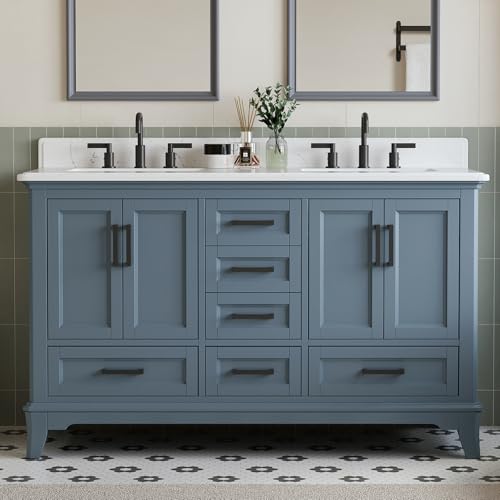
- Large storage - Keep everything organized with ample storage space, eliminating clutter and maximizing efficiency
- Save Time & Effort - This ready-to-use bathroom vanity with sink requires no assembly, saving you valuable time and effort and allowing you to quickly enjoy your renovation. It is
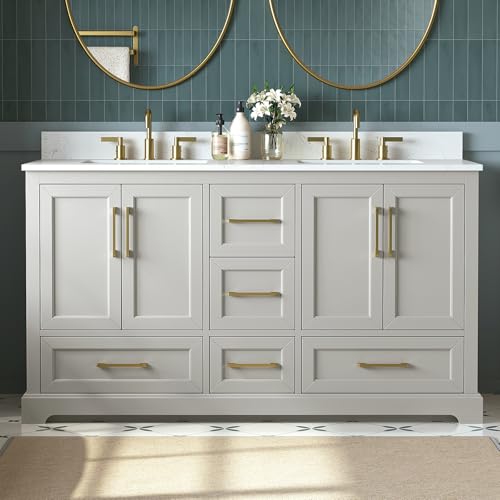
- 【Solid Wood Bathroom Cabinet】The cabinet body is crafted from high-quality Yellow Poplar wood—more eco-friendly, sturdy, and durable than MDF or particleboard—ensuring a longer
- 【Carrara White Marble Countertop】Featuring a pure white engineered marble countertop with a polished surface—clean and elegant, it brings a modern visual charm to your bathroom
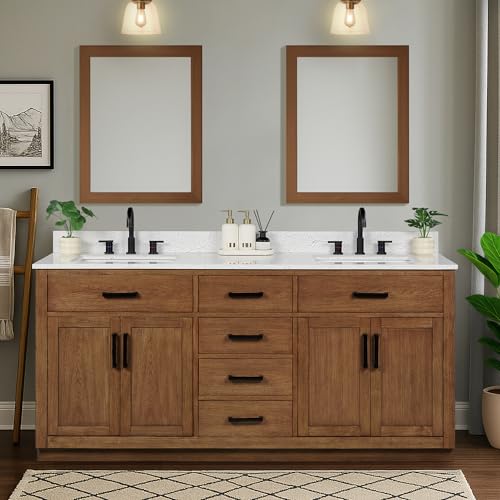
- Premium 72-Inch Bathroom Vanity with Sink: 0.79-inch thick stone countertop-Combines strength and elegance, durable, stylish, and fashion-forward. Enclosed solid wood base
- Convenient Built-In Outlet Space: Built-in outlet space: Convenient for storing hairdryers, electric toothbrushes, and charging devices. The 72-inch bathroom vanity with sink
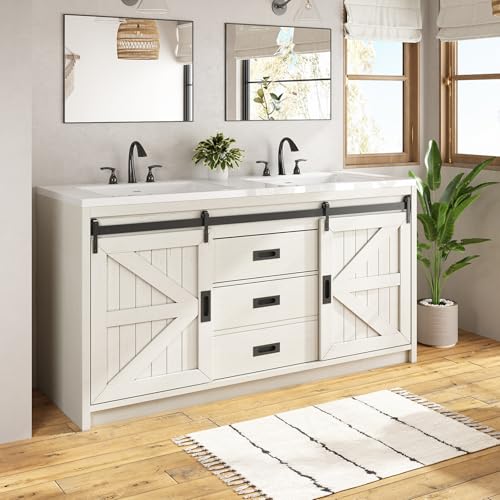
- Integrated Sink:Bathroom double vanity with an integrated sink that is easy to clean without dead corners, features an overflow, and a deep basin that prevents water from
- Sliding Barn Door Design:Bathroom vanity features a sliding barn door that opens to reveal storage space and two independent drawers, perfect for keeping your bathroom essentials
How to choose a double sink master bathroom vanity
Measure the wall first, then everything else. Sixty inches is the practical minimum for two comfortable basins. At 59 inches you're getting two sinks but less elbow room between them; at 72 inches you get real separation and usable counter space between the basins. Also check your door swing and any adjacent walls — a vanity that technically fits the wall but blocks the door is a return shipment nobody enjoys.
Decide how much you care about assembly. This is the biggest hidden cost difference. The DELUXE LIVING pair and the XWNE arrive assembled with sinks and countertops in place — you're connecting plumbing. The budget options come in flat boxes. If you're comfortable with a few hours of instructions and a screwdriver, that's several hundred dollars saved. If you're paying a handyman by the hour, the "expensive" option may not be.
Countertop material is the durability line. Quartz and stone are the long-haul choices. Engineered marble sits close behind and, importantly, doesn't need sealing the way natural marble does. Integrated resin basins are easier to clean because there's no seam, but they're a molded surface rather than stone.
Cabinet material outlasts the finish. Solid wood and plywood resist bathroom humidity better than MDF over the years. That's why the premium listings call it out explicitly. MDF isn't disqualifying — it's a real tradeoff at a real price, and it works fine if you keep water off it.
Budget for faucets unless the listing says otherwise. Only the chartustriable set includes a faucet. The DELUXE LIVING Greige and the XWNE both explicitly exclude faucets, and both use standard 3-hole 8" centerset spacing. Confirm the drain size too — the XWNE lists a 1.75" opening for a 1-1/4" pop-up drain with overflow.
FAQ
Do I need 72 inches for a real double vanity? No. Sixty inches works well for two people, and most of these options land there. Seventy-two inches buys you meaningful counter space between the basins and more drawer capacity — it's a comfort upgrade, not a requirement.
Is a fully assembled vanity worth the extra money? It depends on what your time costs. The assembled units here ship with countertop and sink already installed, so you're doing plumbing hookup only. The flat-pack options need a few hours and a helper for lifting. If you're hiring installation labor, factor in that the assembled units cut billable hours substantially.
Quartz, engineered marble, or an integrated sink — which lasts longest? Quartz and stone are the most durable surfaces on this list. Engineered marble is close and, per the DELUXE LIVING listing, non-porous with no sealing required. Integrated resin sinks trade some of that hardness for seamless cleaning. Any of them beats an unsealed porous surface in a wet room.
What should I check in reviews before buying? Look specifically for comments on delivery damage (these are heavy, and stone tops crack in transit), on whether the drawers align properly after assembly, and on plumbing fit for the drain and faucet spacing. Those are the three areas where a vanity that looks fine in photos causes real problems.
Related guides
- Best bathroom fixtures and vanities - bathroom vanities, bidets, vanity tables and makeup vanities for Seniors
- About Lustreau: Our Editorial Team and Research Standards
- Expert Advice on Best bathroom fixtures and vanities - bathroom vanities, bidets, vanity tables and makeup vanities
Key Takeaways
- Choosing the right best double sink bathroom vanities means matching the key features to your specific needs and budget
- Read real customer reviews and check the return policy before you commit
- Compare value across models — the priciest option is not always the best fit