As an Amazon Associate this site earns from qualifying purchases.
Comparison table
| Vanity | Price | Dimensions | Basin | Storage | Overflow | Faucet holes |
|---|---|---|---|---|---|---|
| LIKIMIO 30" | Check price on Amazon | 30"W × 18"D × 34"H | Ceramic | 2 drawers, 1 soft-close door | Yes | Three, 4" center-set |
| IRONCK 24" | See the product list on this page | 24"W × 18"D × 34"H | One-piece ceramic | 1 full-extension drawer, 2 soft-close doors | Yes | Three, 4" center-set |
| DELUXE LIVING 30" | Check price on Amazon | 31"W × 19"D × 34.5"H | SMC | 2 drawers, open shelf | Yes | Single-hole pre-drilled; 4"/8" marked, drill bit included |
| JUMMICO 24" | Check price on Amazon | Not stated | SMC | 1 oversized drawer | Not stated | Not stated |
| Yaheetech 24" | Check price on Amazon | 24.5"L × 18.5"W × 34"H | Ceramic | 1 drawer, 2 doors, shelf | Not stated | Three, 4" center-set |
| Smhxo 24" | See the product list on this page | 24"W × 18.4"D × 34.7"H | Ceramic (no overflow) | 2 doors | No | Not stated |
Quick answer: For most small bathrooms, the LIKIMIO 30" Bathroom Vanity with Sink, 2 Soft-Close Drawers & 1 Door, White hits the best balance — a standard 30-inch footprint, soft-close hardware, and a proper ceramic sink with overflow. If your space is genuinely tight, drop to a 24-inch model like the IRONCK 24" Bathroom Vanity with Sink, 1 Soft-Close Drawer & 2 Doors, White. If you're just trying to replace an ugly pedestal sink without spending real money, the Smhxo Bathroom Vanity with Ceramic Sink, Bathroom Vanity Cabinet with 2 Doors, 24 Inches Wooden Cabinet with Sink, White is the cheapest way in.
Small-bathroom vanities are one of those categories where the spec sheet matters more than the photos. Every one of these looks fine in a listing image. What actually separates them is depth (18 inches vs. 19 makes a real difference when a door swings), whether the basin is ceramic or SMC, how many faucet holes are pre-drilled, and whether the drawers slide on ball bearings or friction. Here's how the six below actually differ.
LIKIMIO 30" Bathroom Vanity with Sink — Best Overall
Thirty inches wide, 18 inches deep, 34 inches tall — that's the standard American vanity footprint, and the LIKIMIO 30" Bathroom Vanity with Sink, 2 Soft-Close Drawers & 1 Door, White hits it exactly. The 18-inch depth is the number to care about: many 30-inch vanities run 20 to 22 inches deep, which is what eats your floor space when the door swings open.
Finding the right best bathroom vanities small bathrooms comes down to matching the features to how you will actually use it.
The storage layout is smart for a small room. You get one shallow drawer (good for the stuff that otherwise ends up on the counter — razors, hair ties, contact cases) and one deep drawer, both on smooth-gliding rails, plus a soft-close door with adjustable hinges over the cabinet interior. The 3-inch toe-kick is a small detail that matters if you actually stand at your sink for more than ten seconds.
The sink is high-temperature-fired ceramic with a non-porous glazed finish and an overflow channel. It's pre-drilled for three 4-inch center-set faucet holes. Faucet, mirror, and drain are not included, so budget for those. LIKIMIO says assembly runs 1–2 hours with numbered parts. At $205.19 it isn't the cheapest here, but it's the most complete package.
IRONCK 24" Bathroom Vanity with Sink — Best for Very Tight Spaces
When 30 inches simply won't fit — powder rooms, studio apartments, guest baths tucked under a stairwell — the IRONCK 24" Bathroom Vanity with Sink, 1 Soft-Close Drawer & 2 Doors, White is the one I'd shortlist first among the 24-inch options.
It measures 24"W × 18"D × 34"H, and the hardware is a genuine step above what you usually find at this size. The two cabinet doors are soft-close with 6-way adjustable hinges, which means you can square them up after assembly instead of living with a crooked gap forever. The single drawer runs on 3-stage ball-bearing slides with full extension — so you can actually reach what's at the back, rather than fishing blindly.
The basin is one-piece high-fired ceramic with a seamless integrated design, an ultra-smooth non-porous surface, three pre-drilled holes for a 4-inch center-set faucet, and an overflow channel. Finish is white wood grain with a sealed base and a 3-inch toe-kick. Assembly is quoted at 1–2 hours; mirror, faucet, and drain are separate. $188.09.
DELUXE LIVING 30 Inch Bathroom Vanity with Sink — Best for Uneven Floors
Old bathrooms have old floors. If yours slopes, or the tile is uneven, or there's a threshold transition doing something creative, the DELUXE LIVING 30 Inch Bathroom Vanity with Sink, Farmhouse Storage Cabinet with Drawers & Open Storage Shelf, Easy Assembly, Adjustable Feet, Walnut is built for that problem. It has adjustable feet, which both level the cabinet and lift it off the floor — DELUXE LIVING notes this reduces erosion from ground moisture.
The basin is SMC rather than ceramic: stronger and more impact-resistant, less prone to breaking. It has an overflow and comes pre-drilled with a single-hole faucet opening, but here's the useful part — the vanity also marks 4-inch and 8-inch hole locations and ships with a drill bit so you can open up additional holes yourself. That's a genuinely flexible setup if you already own a widespread faucet.
Storage is two drawers plus an open shelf, which reads more "farmhouse" than "hide everything." The walnut finish is the only non-white option in this lineup. Dimensions are 31"W × 19"D × 34.5"H — note it's an inch deeper and half an inch taller than the LIKIMIO, so measure carefully. MDF construction, wear- and corrosion-resistant. $247.00, the most expensive here.
JUMMICO 24" Bathroom Vanity with Sink — Best for Fast Assembly
If you want this done in one evening, the JUMMICO 24" Bathroom Vanity with Sink, Bathroom Storage Cabinet, Black claims 20–30 minutes of assembly — the shortest window of anything on this list.
Design is farmhouse-leaning with a clean look, available in white and black. The build pairs an SMC basin with a frame of synthetic wood panels and stainless steel door hinges. Storage centers on one oversized drawer sized for the daily stuff — toothbrushes, toothpaste, hand sanitizer, towels, mouthwash.
The black finish is worth calling out for small bathrooms specifically. Conventional wisdom says go white to make a small room feel bigger, and that's not wrong, but a dark vanity against a light wall and floor reads as a deliberate anchor rather than clutter. If your bathroom is all white tile, black is often the more interesting call.
Faucet and downpipe are not included. $189.99.
Yaheetech 24" Bathroom Vanity with Sink, 2 Doors & 1 Drawer Cabinet — Best for Plumbing Flexibility
The Yaheetech 24" Bathroom Vanity with Sink, 2 Doors & 1 Drawer Cabinet, White is the only listing here that tells you upfront what plumbing it works with — and that's more valuable than it sounds. Yaheetech specifies that the height from the floor to the wall drain and water inlet should fall between 18.3 and 26.4 inches. Go measure yours before you buy anything, from any brand. It's the single most common cause of a returned vanity.
Specs are unusually complete: 24.5"L × 18.5"W × 34"H, ceramic basin, MDF cabinet, metal hardware. Weight limits are published too — 66 lb on the ceramic basin, 66 lb on the shelf, 44 lb in the drawer. The ceramic countertop is rectangular and extends nearly to the edge, giving you a wider usable basin area than the footprint suggests, with an integrated drain hole and three pre-drilled holes for a 4-inch center-set faucet.
Yaheetech also notes the under-sink space is left open enough to make pipe installation manageable, with a bottom drawer for towels, toilet paper, and soap. Double doors, metal handles, smooth-sliding rails, floor-protective pads underneath. Faucet not included. $149.99.
Smhxo Bathroom Vanity with Ceramic Sink — Best Budget Pick
At $139.99, the Smhxo Bathroom Vanity with Ceramic Sink, Bathroom Vanity Cabinet with 2 Doors, 24 Inches Wooden Cabinet with Sink, White is the cheapest way to replace a pedestal sink with something that actually stores things.
It measures 18.4"D × 24"W × 34.7"H. The ceramic sink is designed without an overflow hole, which Smhxo frames as easier cleaning — fair enough, though it does mean nothing catches a running tap if a drain stopper stays shut. Worth knowing before you commit. Construction is an MDF frame with stainless steel door hinges, and the door is framed rather than flat, which gives it a slightly more traditional look than the flat-panel options here.
Storage is a straightforward two-door cabinet — no drawer. Smhxo quotes 15–30 minutes of assembly with all hardware and instructions included. Faucet and downpipe are not included.
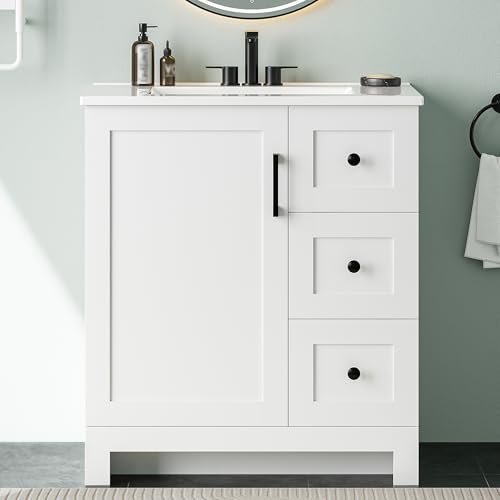
- Modern Matte Vanity: This vanity showcases a crisp matte white finish with clean lines. Its sealed base keeps dust out, while the ergonomic 3-inch toe-kick enhances comfort
- Smart Storage System: The vanity features a soft-close door with adjustable hinges, offering a spacious cabinet interior. It includes one shallow drawer and one deep drawer, each
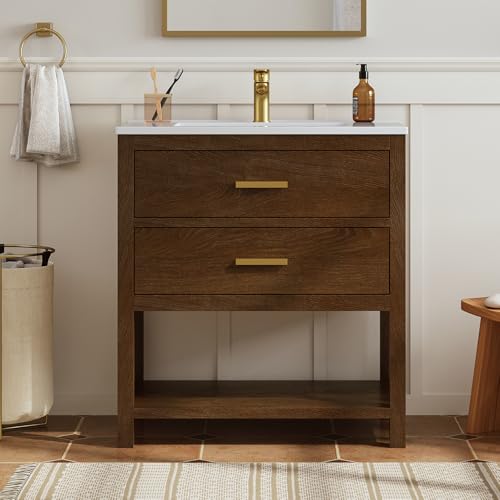
- Sturdy & Durable - The 30 inch bathroom vanity with sink, made of MDF, is sturdy and durable. With its wear-resistant and corrosion-resistant properties, it is also easy to
- SMC Sink - The SMC basin offers greater strength and impact resistance, making it less prone to breaking. Its smooth sink surface is easy to clean. This SMC sink with overflow is
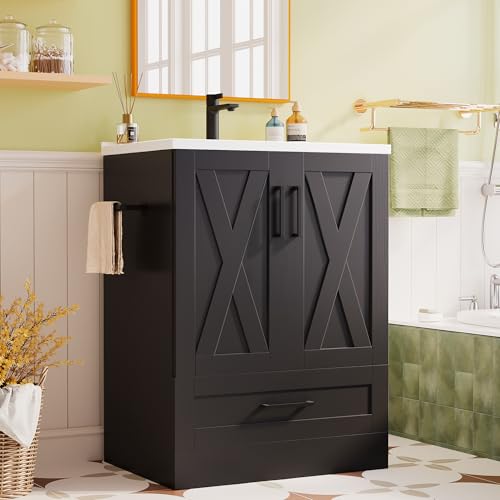
- 【Farmhouse Bathroom Vanity】This bathroom vanity is designed in a rustic style with a very clean look, adding a touch of simplicity to your bathroom decor. Available in white and
- 【Bathroom Sink Construction】The bathroom vanity cabinet comes with a SMC basin and a wooden frame made of synthetic wood panels and stainless steel door hinges for strength and
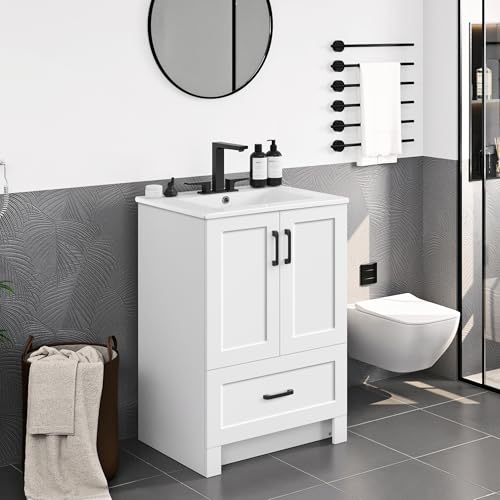
- Specifications: Color: White; Materials: Ceramic Basin, MDF,Metal Hardware; Assembled Dimensions: 24.5″ L × 18.5″ W × 34″ H; Maximum WeightCapacity: Ceramic Basin: 66 lb; Shelf
- Large Storage Space: Tidy up your bathroom and utilizethe storage space beneath the bathroom vanity to maintain cleanliness. Theample space under the sink cabinet offers
How to choose
Measure the drain height first. Yaheetech is the only brand here that publishes a working range — 18.3 to 26.4 inches from the floor to your wall drain and water inlet. That range is roughly typical for freestanding vanities of this height, so use it as a sanity check regardless of which one you buy. If your rough-in sits outside it, you're looking at a plumbing job, not a vanity swap.
Depth beats width in a small room. A 30-inch vanity at 18 inches deep will often feel less cramped than a 24-inch vanity at 20 inches deep, because depth is what protrudes into your walking path. LIKIMIO and IRONCK are both 18 inches. DELUXE LIVING is 19. Smhxo is 18.4, Yaheetech 18.5. The spread is small but real in a room where you're already turning sideways.
Ceramic vs. SMC. Ceramic (LIKIMIO, IRONCK, Yaheetech, Smhxo) gives you a hard, glossy, non-porous surface that wipes clean. SMC (DELUXE LIVING, JUMMICO) is a molded composite — DELUXE LIVING specifically cites greater strength and impact resistance and less tendency to break. If you've got kids swinging hairdryers around, that matters.
Overflow, or no overflow. The LIKIMIO, IRONCK and DELUXE LIVING basins have overflow channels. Smhxo's explicitly does not. An overflow is a small insurance policy against a left-running tap.
Match the faucet holes before you buy the faucet. Three of these (LIKIMIO, IRONCK, Yaheetech) are pre-drilled for 4-inch center-set faucets. DELUXE LIVING ships single-hole but marks 4-inch and 8-inch positions and includes a drill bit. None of the six include a faucet, and most don't include a drain — factor $40–100 into your budget.
Soft-close is not a gimmick. In a small bathroom, the vanity is within slamming distance of everything. LIKIMIO and IRONCK both use soft-close hardware with adjustable hinges, which also lets you correct door alignment after assembly.
Before you commit, go read the recent reviews on the specific listing — particularly anything mentioning shipping damage to the basin, which is the most common failure point for a sink shipped in one box.
FAQ
What size vanity fits a small bathroom? Twenty-four inches wide is the standard compact size and works in powder rooms and tight guest baths — that's the Smhxo, Yaheetech, JUMMICO, and IRONCK options here. Thirty inches (LIKIMIO, DELUXE LIVING) is the standard full-size vanity and still fits many "small" bathrooms if you have the wall run. Depth matters more than width in a narrow room; aim for 18 inches where you can.
Do these come with a faucet? No. Smhxo, JUMMICO, LIKIMIO, IRONCK, and Yaheetech all list the faucet as not included, and Smhxo and JUMMICO also exclude the downpipe. LIKIMIO and IRONCK additionally exclude the mirror and drain. Buy the faucet to match the pre-drilled hole configuration, not the other way around.
How hard are these to assemble? It varies more than you'd expect. Smhxo quotes 15–30 minutes and JUMMICO quotes 20–30. LIKIMIO and IRONCK both quote 1–2 hours, with numbered components and illustrated instructions. DELUXE LIVING numbers each part for easier assembly. None of these are flat-pack nightmares, but the 30-inch models are heavier and awkward to handle alone.
What if my bathroom floor isn't level? The DELUXE LIVING 30 Inch Bathroom Vanity is the one built for this — it has adjustable feet designed to adapt to uneven floors, which also lift the cabinet away from ground moisture. For the others you'd be shimming manually.
Related guides
- How to Organize a Makeup Vanity That Stays Organized
- Top 10 Tips for Best bathroom fixtures and vanities - bathroom vanities, bidets, vanity tables and makeup vanities
- Best bathroom fixtures and vanities - bathroom vanities, bidets, vanity tables and makeup vanities After Recent Issues
Key Takeaways
- Choosing the right best bathroom vanities small bathrooms means matching the key features to your specific needs and budget
- Read real customer reviews and check the return policy before you commit
- Compare value across models — the priciest option is not always the best fit