As an Amazon Associate this site earns from qualifying purchases.
Specification comparison
| Product | Price | Width × Depth × Height | Top material | Storage layout | Faucet holes |
|---|---|---|---|---|---|
| Yaheetech 24" Bathroom Vanity with Sink, 2 Doors & 1 Drawer Cabinet, White | Check price on Amazon | 24.5" × 18.5" × 34" | Ceramic basin, MDF cabinet | 2 doors, 1 drawer | 3 holes, 4" center-set |
| LIKIMIO 30" Bathroom Vanity with Sink, 2 Soft-Close Doors, White | Check price on Amazon | 30" × 18.3" × 34" | Ceramic, integrated | 2 soft-close doors, 3-level adjustable shelf | 3 holes, 4" center-set |
| LIKIMIO 30" Bathroom Vanity with Sink, 2 Soft-Close Drawers & 1 Door, White | Check price on Amazon | 30" × 18" × 34" | Ceramic, integrated | 1 soft-close door, 1 shallow + 1 deep drawer | 3 holes, 4" center-set |
| LIKIMIO 36" Bathroom Vanity with Sink, 1 U-Shaped Drawer & 2 Doors, White | Check price on Amazon | 36" × 18.3" × 35" | Ceramic, integrated | 1 U-shaped drawer, 2 soft-close doors | 3 holes, 4" center-set |
| DELUXE LIVING 36 Inch Bathroom Vanity with Sink, Black Single Sink Bathroom Vanity with Integral Top | See the product list on this page | 37" × 19" × 34.5" | Solid surface composite, MDF + melamine cabinet | 4 drawers, 2 soft-close doors | Pre-drilled single-hole; 4" and 8" locations marked, drill bit included |
| AMERLIFE 48" Farmhouse Freestanding Vanity with Sink and Deep Basin | See the product list on this page | Not stated | Acrylic top, MDF cabinet | Sliding barn door + 4 drawers | Not stated |
Quick answer: For most single-sink bathrooms, a freestanding vanity in the 24–36 inch range with an integrated ceramic or composite top solves storage and plumbing in one purchase, and prices in that band start around $150. The three specs that decide whether it works are width, depth, and whether your drain and supply lines line up with the cabinet's open back. Everything else — soft-close hinges, drawer layout, finish — is comfort, not fit.
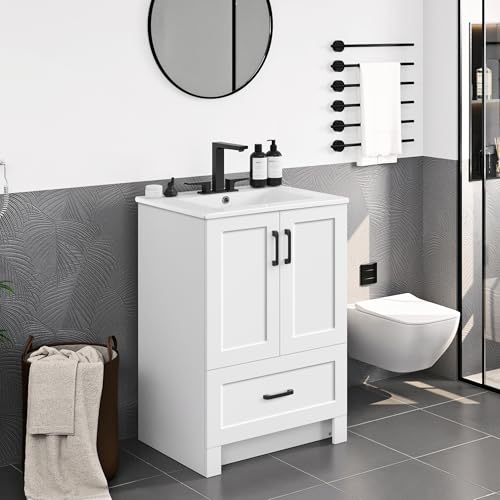
- Specifications: Color: White; Materials: Ceramic Basin, MDF,Metal Hardware; Assembled Dimensions: 24.5″ L × 18.5″ W × 34″ H; Maximum WeightCapacity: Ceramic Basin: 66 lb; Shelf
- Large Storage Space: Tidy up your bathroom and utilizethe storage space beneath the bathroom vanity to maintain cleanliness. Theample space under the sink cabinet offers
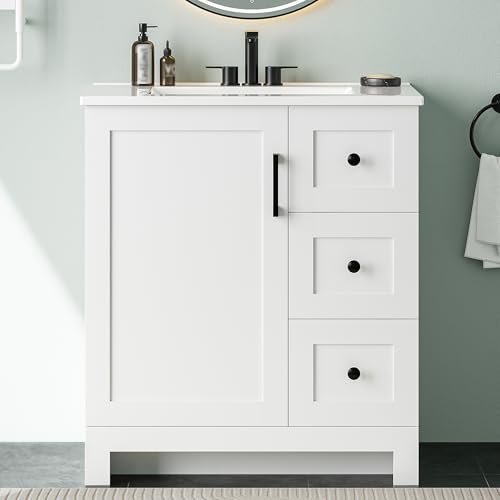
- Modern Matte Vanity: This vanity showcases a crisp matte white finish with clean lines. Its sealed base keeps dust out, while the ergonomic 3-inch toe-kick enhances comfort
- Smart Storage System: The vanity features a soft-close door with adjustable hinges, offering a spacious cabinet interior. It includes one shallow drawer and one deep drawer, each
Measure these four things first
Width. Leave a few inches of clearance on each side unless you're building into an alcove. A 36" cabinet in a 38" gap looks intentional; in a 36.5" gap it's a wrestling match.
Depth and door swing. Most of these run 18–19 inches deep. In a small bathroom, the killer isn't the cabinet — it's the door of the room hitting the vanity corner. Tape the footprint on the floor and open your bathroom door before you order.
The best bathroom vanity buying guide for your situation depends on how you plan to use it and where.
Height. These sit at 34" to 35". Standard countertop height is 36", and older "comfort height" builds go higher. The LIKIMIO 36" Bathroom Vanity with Sink, 1 U-Shaped Drawer & 2 Doors, White is the tallest of this group at 35". If you're over six feet, an inch matters more than you'd think.
Plumbing rough-in. This is the one people skip. Yaheetech states the height from the floor to the wall drain and water inlet should be between 18.3 and 26.4 inches for its 24" cabinet. If your drain sits outside that band, you're adding an adapter or moving pipe. The LIKIMIO 30" Bathroom Vanity with Sink, 2 Soft-Close Doors, White states compatibility with both floor and wall drainage, which gives you more room to be wrong.
Doors vs. drawers: pick your storage religion
Doors give you one big cave. Great for tall bottles, a bucket, spare toilet paper in bulk. Bad for small items, which migrate to the back and die there. The LIKIMIO 30" Bathroom Vanity with Sink, 2 Soft-Close Doors, White leans this way, with a three-level adjustable shelf so you can tune the cave to your bottle heights.
Drawers give you visibility — you see everything at once. But the P-trap eats the middle of the cabinet, so drawers under a sink are either shallow or U-shaped to wrap the plumbing. That's exactly what the U-shaped drawer on the LIKIMIO 36" is doing, and the brand notes it holds more than a tip-out drawer.
The DELUXE LIVING 36 Inch Bathroom Vanity with Sink, Black Single Sink Bathroom Vanity with Integral Top is the drawer-heavy option here with four drawers plus two doors, at a higher price.
Who this class of vanity is for
- You have one sink, a standard rough-in, and a bathroom between roughly 24 and 48 inches of usable wall.
- You're comfortable assembling flat-pack furniture. LIKIMIO estimates 1–2 hours with numbered parts and step-by-step instructions.
- You want the sink and top to arrive as one integrated piece, so you're not sourcing a countertop and undermount separately.
- You're fine buying the faucet and drain separately — none of these include them.
Who should skip it
- You need double sinks. Nothing here is a double vanity.
- You want a wall-mounted floating look. These are freestanding floor cabinets.
- Your bathroom is genuinely wet-prone — a windowless room with no exhaust fan, standing humidity. MDF and engineered wood cores tolerate splashes, not chronic saturation.
- You already own a faucet with a spread you can't change. Four of these are pre-drilled for 4" center-set faucets only. A widespread 8" faucet will not fit those tops. The DELUXE LIVING is the flexible one: pre-drilled single-hole, with 4" and 8" locations marked and a drill bit in the box.
- You need weight capacity for heavy stone or appliances. Yaheetech publishes limits — 66 lb basin, 66 lb shelf, 44 lb drawer. That's normal-bathroom-stuff territory.
Honest trade-offs
Price buys hinges, not structure. The gap between $150 and $250 here is mostly soft-close hardware, drawer glides, and finish quality. Every one of these uses an MDF or engineered wood cabinet. Nobody at this price is selling you solid hardwood.
Ceramic vs. composite vs. acrylic. Ceramic tops (Yaheetech, all three LIKIMIO units) are glazed, non-porous, and easy to wipe — but ceramic chips if you drop something heavy. DELUXE LIVING uses a solid surface composite it describes as more impact-resistant and less prone to breaking. AMERLIFE uses a high-strength acrylic top. If you have kids who launch things, that difference is worth $100.
Bigger means more shipping risk. The AMERLIFE 48" ships in two packages. More boxes, more chances one arrives dented, more staging space needed in a small home.
Assembly is real work. "1–2 hours" assumes you have a second person for the top and a level floor. Budget an afternoon and set the adjustable feet before you connect any plumbing.
What to check on the listing before you buy
Listings change constantly, so verify these yourself at the moment of purchase rather than trusting any article — including this one.
- Current price and variant. Color and size options often sit under one listing at different prices. Confirm the swatch you selected is the one being priced.
- Exact dimensions for your chosen variant. A 30" and 36" version of the same model won't share depth or height.
- What's in the box. Faucet, mirror, and drain are excluded on the LIKIMIO units. Assume excluded unless the listing says otherwise.
- Warranty terms and the return window — including who pays return shipping on something this large and heavy.
- Recent customer reviews and posted photos. Go read them yourself, sorted by most recent, and look specifically for damage-in-transit and part-shortage reports.
Consider instead if…
AMERLIFE 48" Farmhouse Freestanding Vanity with Sink and Deep Basin — consider instead if…
You have the wall space for 48 inches and want the storage that comes with it. The AMERLIFE 48" Farmhouse Freestanding Vanity with Sink and Deep Basin uses sliding barn doors instead of swinging ones, which is a real win in a narrow bathroom where a swung door would block the walkway. Behind them is space sized for taller items, plus four sliding drawers. The deep basin is designed to cut splashing, and the handles are hidden metal with a waterproof coating. At $449.99 it's the priciest option here, and dimensions aren't stated on the listing — measure carefully and confirm before ordering.
Yaheetech 24" Bathroom Vanity with Sink, 2 Doors & 1 Drawer Cabinet, White — consider instead if…
Your bathroom is genuinely tight. At 24.5" × 18.5" × 34" and $149.99, the Yaheetech 24" Bathroom Vanity with Sink, 2 Doors & 1 Drawer Cabinet, White is the smallest and cheapest here. It's also the only one publishing explicit load limits and a rough-in range, which is unusually useful information to have before you order. The rectangular ceramic top runs nearly to the cabinet edge for more usable basin, and floor-protective pads are included.
LIKIMIO 30" Bathroom Vanity with Sink, 2 Soft-Close Drawers & 1 Door, White — consider instead if…
You want drawers but only have 30 inches. The LIKIMIO 30" Bathroom Vanity with Sink, 2 Soft-Close Drawers & 1 Door, White splits the difference with one shallow and one deep drawer alongside a single soft-close door — so small items get a home without giving up cabinet space entirely. Matte white finish, sealed base to keep dust out, 3-inch toe-kick, and an overflow channel on the ceramic sink. $205.19.
FAQ
Do any of these include a faucet? No. Every listing here that addresses it says the faucet is not included, and LIKIMIO also excludes the mirror and drain. Budget separately, and buy the faucet after you've confirmed your top's hole spacing.
Can I fit an 8-inch widespread faucet? Only on the DELUXE LIVING, which comes pre-drilled for a single-hole faucet and marks both 4" and 8" locations with a drill bit included. The Yaheetech and all three LIKIMIO tops are drilled for 4" center-set faucets.
Is 34 inches too short? It's a common height for freestanding vanities and both LIKIMIO and DELUXE LIVING frame it as reducing back strain. If you're tall, the LIKIMIO 36" at 35" high is the tallest option listed. If you want true 36" counter height, you'd be adding a base — plan for it rather than discovering it.
How much of the cabinet does the plumbing eat? Enough that it changes what fits. That's why under-sink drawers are shallow or U-shaped. If you need full-depth drawers, look at the DELUXE LIVING's four-drawer layout or the AMERLIFE's four sliding drawers, which put drawer space beside the basin rather than directly under it.
Related guides
- Step-by-Step Best bathroom fixtures and vanities - bathroom vanities, bidets, vanity tables and makeup vanities Process
- How Lustreau Researches Products
- Best bathroom fixtures and vanities - bathroom vanities, bidets, vanity tables and makeup vanities with High Value Assets
Key Takeaways
- Choosing the right bathroom vanity buying guide means matching the key features to your specific needs and budget
- Read real customer reviews and check the return policy before you commit
- Compare value across models — the priciest option is not always the best fit